
Trading is not about winning every trade.
Even the best traders in the world experience losing trades. The real difference between consistently profitable traders and consistently losing traders is how they manage their winners and, more importantly, how they control their losses.
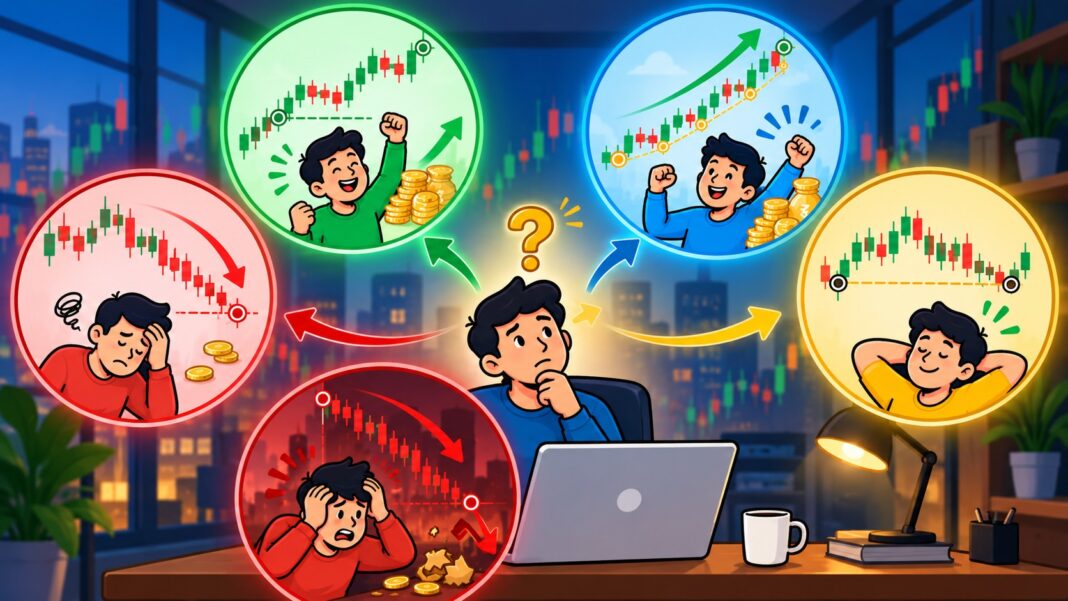
Every trade you take should ideally end in one of only four ways:
- A small win
- A big win
- A small loss
- Break-even
There should be no fifth category:
A big loss.
A big loss can damage not only your trading account but also your confidence, discipline, and decision-making.
Let’s look at each type of trade in detail.
1. A Small Win
A small win happens when you enter a trade, the price moves in your favour, and you take a relatively quick profit.
For example:
You buy a stock at Rs. 100.
The stock moves to Rs. 103, and you decide to take your profit.
Your gain is approximately 3%.
This is a small winning trade.
Small wins are not necessarily bad. They can be useful when:
- The market is moving sideways.
- Momentum is weakening.
- Your original setup is no longer as strong.
- You are trading a short-term opportunity.
- The price reaches your predefined target.
- The market environment does not support a large trend.
The important point is that you should not turn a small winning trade into a losing trade simply because you became greedy.
If your trading plan says to take a profit, take it.
However, there is an important lesson here:
Do not automatically take every small profit.
Sometimes a stock that gives you a 3% gain may eventually become a 10%, 20%, or even larger move.
That leads us to the second and most important type of trade.
2. A Big Win
A big win is what can make a trading strategy highly profitable over the long term.
A big winning trade happens when you correctly identify a strong trend and allow the position to continue moving in your favour.
For example:
You buy a stock at Rs. 100.
Instead of selling at Rs. 103, the stock continues:
Rs. 105 → Rs. 110 → Rs. 118 → Rs. 125 → Rs. 135
Eventually, the trend starts weakening and you exit at Rs. 130.
You have made approximately 30%.
This is a big winning trade.
The important lesson is:
You do not need to know exactly how far a stock will rise. You need to know how to stay in the trade while the trend remains in your favour.
This is where trailing stops become extremely useful.
Instead of setting a fixed profit target and automatically selling at that price, you can allow the market to determine how far the trade can go.
For example:
- Entry: Rs. 100
- Initial stop: Rs. 95
- Price rises to Rs. 110
- Stop is moved higher
- Price rises to Rs. 120
- Stop is moved higher again
- Price eventually reverses
- You exit at Rs. 115
You allowed the trade to run while protecting a significant portion of your profit.
This creates an important asymmetry in your trading.
You know your potential loss before entering the trade, but you allow your potential profit to remain open.
That is one of the foundations of a strong risk/reward approach.
Why big winners matter
Imagine you have these five trades:
- Trade 1: +2%
- Trade 2: -1%
- Trade 3: -1%
- Trade 4: -1%
- Trade 5: +10%
Your total result is:
+9%
The three small losses did not destroy the account because the big winner was allowed to compensate for them.
This is why successful traders don’t necessarily need a very high win rate.
They need to make sure that:
Their losses are controlled and their best winners have room to become large winners.
3. A Small Loss
A small loss is not a failure.
It is a normal part of trading.
You enter a trade because you believe the probability is in your favour. But after entering, the market may prove your analysis wrong.
For example:
You buy at Rs. 100.
Your analysis says the stock should move higher.
You place a stop loss at Rs. 96.
Instead, the stock falls to Rs. 96.
Your stop loss is triggered.
You lose approximately 4%.
This is a small loss.
The key is what happens next.
A disciplined trader accepts:
“My trade idea did not work. I was wrong on this particular trade, so I will exit and protect my capital.”
An undisciplined trader may say:
“I’ll wait. It will probably come back.”
Then Rs. 96 becomes Rs. 92.
Then Rs. 92 becomes Rs. 85.
Eventually, a small loss becomes a major loss.
That is how trading accounts can be seriously damaged.
A small loss is the cost of doing business
Think of a stop loss as an insurance mechanism.
You are not using a stop loss because you expect to lose.
You use it because you understand that your prediction can be wrong.
The objective is not:
“Never lose.”
The objective is:
“When I am wrong, lose a small and manageable amount.”
4. Break-Even Trade
The fourth type is a break-even trade.
This happens when you exit a trade with little or no loss after the position has moved in your favour.
For example:
You buy at Rs. 100.
The stock rises to Rs. 105.
You move your stop loss to your entry price of Rs. 100.
Later, the stock reverses and hits your stop.
You exit around Rs. 100.
The trade is approximately break-even before transaction costs.
This can happen for several reasons.
Time Stop
Sometimes the price simply does not move as expected.
You entered because you expected the stock to move within a few days, but after several days nothing happens.
Instead of keeping your capital trapped indefinitely, you may decide:
“This trade is not working within my expected timeframe.”
You exit and move your capital to another opportunity.
Trailing Stop
Another possibility is that the trade initially moves in your favour.
You protect the position by moving your stop toward your entry price.
If the market reverses, you exit around break-even.
This is a useful outcome because you gave the trade an opportunity to work while protecting your capital.
The Fifth Type Should Not Exist: A Big LossThis is the most important part of the entire concept.There are four acceptable outcomes:
Small win → Big win → Small loss → Break-even
But there should not be:
Big loss.
Why?
Because recovering from a large loss becomes increasingly difficult.
Consider this:
| Account Loss | Gain Needed to Recover |
|---|---|
| -5% | +5.3% |
| -10% | +11.1% |
| -20% | +25% |
| -30% | +42.9% |
| -40% | +66.7% |
| -50% | +100% |
| -60% | +150% |
Notice what happens.
A 10% loss requires an 11.1% gain to recover.
But a 50% loss requires a 100% gain just to return to where you started.
This is why capital preservation is so important.
A trader who protects capital can stay in the game.
A trader who repeatedly suffers large losses eventually loses the ability to continue trading effectively.
How Do You Prevent Big Losses?
There are three important tools.
1. Proper Position Sizing
Your position size should be based on how much you are willing to lose if the trade reaches your stop loss.
Suppose you have a Rs. 500,000 trading account.
You decide that you are willing to risk only 1% of your account on one trade.
Your maximum planned risk is:
Rs. 500,000 × 1% = Rs. 5,000
Now suppose:
- Entry price = Rs. 100
- Stop loss = Rs. 95
- Risk per share = Rs. 5
Your position size would be:
Rs. 5,000 ÷ Rs. 5 = 1,000 shares
Your position value is:
1,000 × Rs. 100 = Rs. 100,000
The important point is that you don’t decide your position size simply because you “like” the stock.
You calculate the position size based on:
Account size + acceptable risk + stop-loss distance.
This becomes even more important when trading volatile stocks.
2. Use a Proper Stop Loss
A stop loss is designed to answer one simple question:
“At what price is my trading idea no longer valid?”
The stop should not simply be placed at a random percentage.
It should make sense based on the stock’s:
- Market structure
- Support and resistance
- Volatility
- ATR
- Recent price action
- Trading setup
For example, if you buy because a stock breaks above resistance, your stop might need to be below the breakout structure rather than simply 2% below your entry.
A good stop loss protects you from being trapped in a trade that is no longer behaving as expected.
3. Accept When You Are Wrong
This is probably the hardest part of trading.
Your analysis can be good and your trade can still lose.
You can have:
- A strong technical setup
- Good fundamentals
- Positive market conditions
- A proper entry
- A well-defined stop
And the trade can still fail.
That does not necessarily mean your strategy is bad.
It simply means one individual trade did not work.
The professional response is:
Accept the loss. Learn from it. Move on.
The dangerous response is:
Hope → Hold → Average down → Refuse to exit → Large loss
Good Trade vs. Winning Trade
There is another very important lesson from Larry Hite’s quote.
A good trade and a winning trade are not necessarily the same thing.
You can take a good trade and lose money.
For example, you identify a strong breakout, calculate your risk correctly, use a proper stop loss, and enter according to your strategy.
But the breakout fails.
You lose 1%.
That is still a good trade, even though you lost money.
Why?
Because you followed your process.
On the other hand, you can make money from a bad trade.
For example:
You enter a stock without analysis.
You don’t use a stop loss.
The stock unexpectedly rises 10%.
You make money.
Was it a good trade?
No.
It was a bad decision that happened to produce a profitable outcome.
This distinction is extremely important.
Never Confuse Luck With Skill
One of the most dangerous things in trading is making money from a bad decision.
Why?
Because it can teach your brain the wrong lesson.
Imagine you buy a stock without research.
You have no entry plan.
You have no stop loss.
You are simply hoping the price will rise.
Unexpectedly, the stock rises 15%.
You make a large profit.
You may start thinking:
“My instinct is excellent.”
Next time, you take an even larger position.
But the next stock falls 20%.
Because you never had a risk-management plan, a manageable mistake becomes a major loss.
This is why a winning trade is not automatically a good trade.
The quality of your trading should be judged by your process, not just by the result of one trade.
Think in Probabilities, Not Predictions
Nobody can predict the market with certainty.
Your job is not to predict every future price movement.
Your job is to put yourself in situations where the odds are favourable and the downside is controlled.
Think about a casino.
A casino does not need to win every individual game.
It simply needs a statistical advantage over a large number of games.
Trading works in a similar way.
You may lose several individual trades.
But if your system produces:
- Small losses when you are wrong
- Break-even trades when the market goes nowhere
- Small wins from short-term opportunities
- Occasional large winners when trends develop
you can still become profitable over a large number of trades.
The Real Objective of Trading
Many beginners focus on:
“How can I find more winning stocks?”
A better question is:
“How can I control my losses while giving my best trades enough room to become big winners?”
That shift in thinking can completely change your approach to trading.
You don’t need to win every trade.
You don’t even need to be right most of the time.
You need to make sure that:
When you are wrong → lose small.
When nothing happens → protect capital.
When you are slightly right → take a reasonable profit when appropriate.
When you are very right → stay with the trend and allow the winner to grow.
That is the foundation of asymmetric trading.
The Four Outcomes
Think of every trade as belonging to one of these four categories:
1. Small Win
Take a controlled profit when the opportunity is short-term or the setup weakens.
2. Big Win
Stay with a strong trend and use a trailing stop to allow the winner to grow.
3. Small Loss
Accept that the trade idea failed and exit according to your risk-management plan.
4. Break-Even
Protect capital when the trade fails to develop or when you can exit around your entry after protecting the position.
And remember:
There should be no fifth outcome.
Big Loss.
Your goal as a trader is not to eliminate losses.
Your goal is to eliminate catastrophic losses.
If you can consistently keep losses small, protect your capital, and allow your best trades to become big winners, you give yourself something extremely valuable:
the ability to stay in the game long enough for your trading edge to work.
As Larry Hite’s famous principle suggests, you can lose a good bet even when the odds were in your favour. But if you consistently make good decisions and keep taking trades where the odds are favourable, the law of probabilities can work in your favour over time.
Don’t focus on being right every time.
Focus on managing risk every time.
Because in trading, survival comes first. Profit comes second.
And the trader who survives long enough to let their edge compound is the trader who has the opportunity to succeed for years.