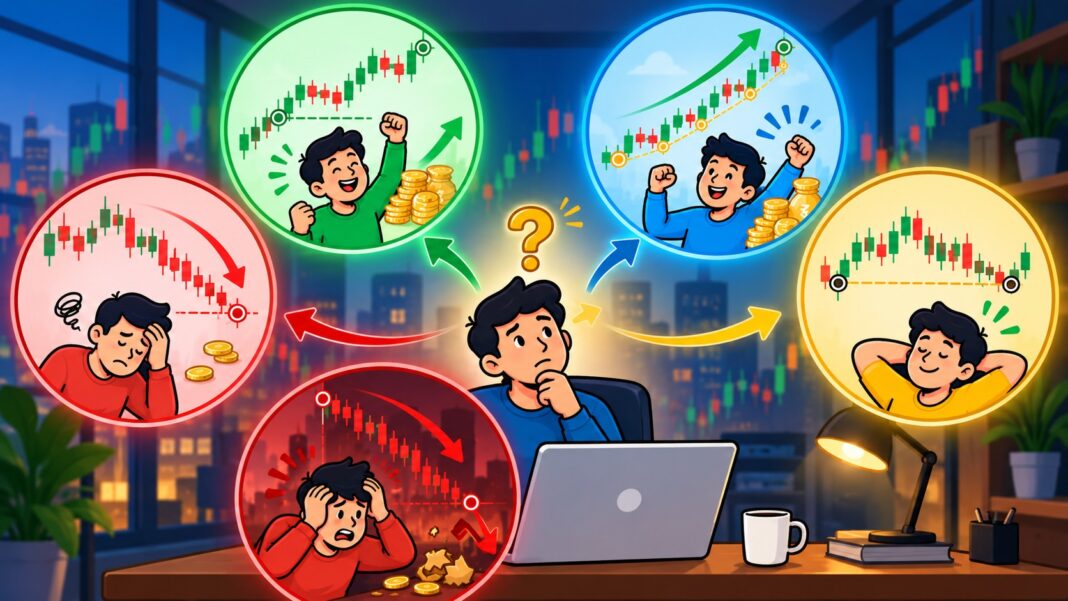

One of the biggest mistakes new investors make is believing that the stock market moves only because of company profits, economic news, or interest rates. While these factors certainly matter, they do not tell the whole story. The stock market is also driven by something far more powerful—human psychology.
Prices move because people buy and sell. People buy and sell because of their emotions. Fear, hope, greed, confidence, and panic influence investment decisions more than most investors realize.
This is why the market cycle keeps repeating throughout history. Whether you study the Colombo Stock Exchange (CSE), the New York Stock Exchange (NYSE), or any other financial market, you will notice the same emotional pattern occurring again and again.
Technology changes. Companies change. Investors change.
But human emotions remain the same.
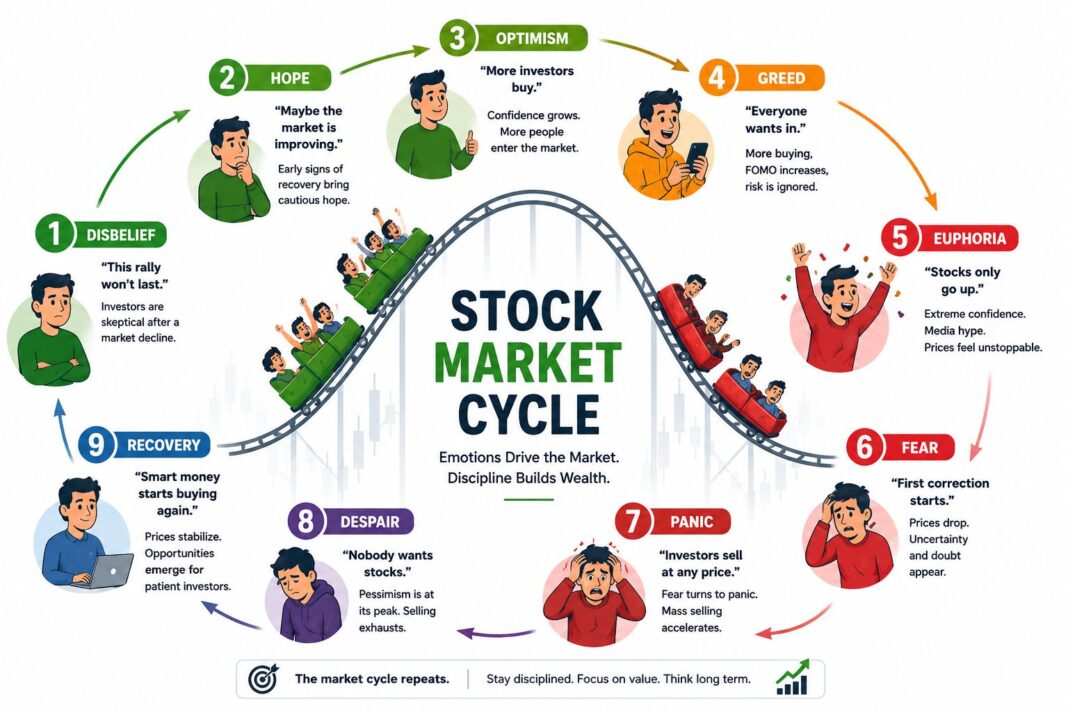
Understanding the market cycle will not help you predict the exact top or bottom of the market, but it can help you avoid emotional decisions and become a more disciplined investor.
Stage 1: Disbelief – “This Rally Won’t Last”
Every new bull market begins with disbelief.
Usually, this stage appears after a long bear market or a major market correction. Most investors have recently experienced losses and have lost confidence in stocks. Even when prices begin to recover, people remain skeptical.
You’ll often hear comments like:
- “This is just a temporary bounce.”
- “The market will fall again.”
- “I’m waiting for lower prices.”
Many investors refuse to buy because they are still emotionally attached to the previous decline.
Ironically, this is often when experienced investors and institutional investors quietly begin accumulating quality companies.
Stage 2: Hope – “Maybe the Market Is Improving”
As prices continue to rise, confidence slowly returns.
Positive company earnings, improving economic conditions, or stronger market sentiment encourage investors to believe that conditions are getting better.
Investors who missed the first part of the rally begin to think:
“Maybe I should start investing again.”
Trading activity gradually increases, and more buyers enter the market.
However, many investors are still cautious because they remember the previous losses.
Stage 3: Optimism – More Investors Buy
At this stage, the uptrend becomes more obvious.
More companies report better financial performance. News headlines become increasingly positive. Analysts begin raising target prices.
Investors who waited on the sidelines now start buying.
People begin discussing stocks with friends, family members, and colleagues.
Portfolio values increase, boosting investor confidence.
This stage usually represents a healthy bull market supported by improving fundamentals and growing optimism.
Stage 4: Greed – Everyone Wants In
As stock prices continue rising, greed starts replacing careful analysis.
Many investors no longer ask:
“Is this company worth buying?”
Instead, they ask:
“How much higher can it go?”
People become afraid of missing out (FOMO).
Even investors with little knowledge of the stock market rush to open trading accounts.
Speculation increases.
Risk management is often ignored because investors believe every stock will continue rising.
During this phase, even poor-quality companies may experience strong price increases simply because money is flowing into the market.
Stage 5: Euphoria – “Stocks Only Go Up”
This is the most dangerous stage of every market cycle.
Confidence reaches extreme levels.
Many investors become convinced that the market cannot fall.
Common statements include:
- “This time is different.”
- “Stocks only go up.”
- “Every dip is a buying opportunity.”
- “You can’t lose money in this market.”
Media attention becomes overwhelming.
Everyone talks about stocks.
New investors believe investing is easy because almost every purchase seems profitable.
Unfortunately, this is often when market risk is at its highest.
Valuations become stretched, expectations become unrealistic, and even small disappointments can trigger selling.
History has shown that every major market bubble eventually reaches this stage before reversing.
Stage 6: Fear – The First Correction Begins
Eventually, the market stops rising.
Prices begin falling.
Initially, investors dismiss the decline as a normal correction.
Many continue buying because previous corrections quickly recovered.
However, uncertainty slowly grows.
Questions begin to appear:
- “Why are prices falling?”
- “Should I reduce my positions?”
- “Is this only temporary?”
Confidence starts weakening.
Stage 7: Panic – Investors Sell at Any Price
When prices continue falling, fear turns into panic.
Investors who bought near the top suddenly face significant losses.
Many decide they simply want to protect whatever money remains.
Instead of asking whether a company is fundamentally strong, they sell because emotions take control.
Headlines become negative.
Social media fills with pessimistic opinions.
Selling accelerates as more investors rush to exit.
Ironically, this is when many investors sell quality companies at heavily discounted prices.
Stage 8: Despair – Nobody Wants Stocks
This is the emotional opposite of euphoria.
Investors become exhausted.
Many promise never to invest again.
Stock discussions disappear.
News coverage focuses only on negative developments.
Even fundamentally strong companies may trade at attractive valuations because buyers have disappeared.
This stage often creates some of the best long-term investment opportunities, but very few investors have the confidence to buy.
Stage 9: Recovery – Smart Money Starts Buying Again
Eventually, selling pressure weakens.
Prices stabilize.
Experienced investors begin accumulating quality businesses while public sentiment remains negative.
At first, few people notice the recovery.
The media is still pessimistic.
Retail investors remain cautious.
Yet this is often where the next market cycle quietly begins.
Once prices continue improving, disbelief returns—and the entire cycle repeats.
How This Applies to the Colombo Stock Exchange
The Colombo Stock Exchange has experienced this emotional cycle many times.
During strong bull markets, investor confidence increases rapidly, trading volumes rise, and many believe prices will continue climbing indefinitely.
When corrections occur, sentiment changes just as quickly. Investors who were previously optimistic suddenly become fearful, and selling pressure increases.
Eventually, confidence disappears altogether, creating opportunities for patient investors who focus on business quality rather than short-term emotions.
While every market cycle is different, the underlying investor psychology remains remarkably similar.
This is why understanding emotions is often just as important as understanding financial statements.
Lessons Every Investor Should Remember
Successful investing is not about predicting every market move.
It is about recognizing where market sentiment may be and avoiding emotional decisions.
A few timeless lessons include:
- Don’t become overly optimistic simply because prices have been rising.
- Don’t panic simply because prices have fallen.
- Focus on business fundamentals rather than market emotions.
- Maintain a long-term investment strategy.
- Always manage risk, regardless of market conditions.
The investors who consistently succeed are rarely the smartest.
They are usually the ones who remain disciplined when everyone else becomes emotional.
Final Thoughts
Markets are driven by numbers, but investors are driven by emotions.
The emotional cycle of Disbelief → Hope → Optimism → Greed → Euphoria → Fear → Panic → Despair → Recovery has repeated throughout financial history and will likely continue repeating in the future.
No one can consistently predict exactly when each stage will begin or end.
However, investors who understand this cycle are less likely to chase prices during periods of euphoria and less likely to sell quality investments during periods of panic.
In the end, successful investing is not just about choosing the right stocks.
It is about mastering your own emotions.
Because while markets change, human psychology never does.