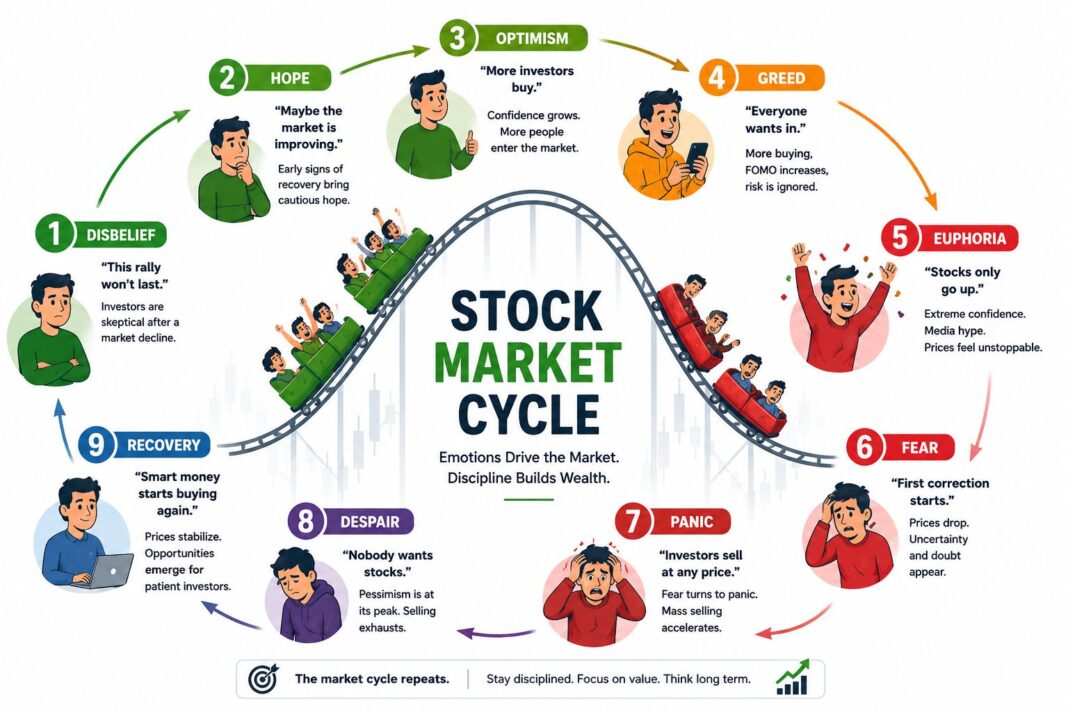

Most investors obsess over how much they can make. Nicolas Darvas became a millionaire by asking a different question: “How much can I lose?” That mindset changed everything. The stock market doesn’t destroy investors because they miss winners—it destroys them because they ignore risk.
Most investors enter the stock market asking one question:
“How much money can I make?”
Legendary trader Nicolas Darvas asked a completely different question:
“How much can I lose if I’m wrong?”
This simple shift in mindset was one of the key reasons Darvas turned a modest investment account into millions of dollars, a journey he documented in his classic book How I Made $2,000,000 in the Stock Market.
The Difference Between Average Investors and Successful Traders
Imagine buying a stock at Rs. 100.
Immediately, your mind begins calculating potential profits:
- What if it reaches Rs. 120?
- What if it climbs to Rs. 150?
- What if it doubles to Rs. 200?
Your attention becomes fixed on the upside.
Then the stock starts falling:
- Rs. 95 – “It’s only a temporary pullback.”
- Rs. 90 – “This is a buying opportunity.”
- Rs. 80 – “It will recover eventually.”
- Rs. 50 – “I can’t sell now after losing so much.”
This is how many investors turn manageable losses into devastating ones.
The problem isn’t the stock.
The problem is that they never planned what to do if they were wrong.
Darvas’s Risk-First Approach
Before buying a stock, Darvas always defined his risk.
If he bought at Rs. 100, he would determine in advance:
- Where is my stop loss?
- How much am I willing to lose?
- Is the risk acceptable?
For example:
- Entry Price = Rs. 100
- Stop Loss = Rs. 92
- Maximum Risk = 8%
Now the trade has a clearly defined outcome.
If the stock falls to Rs. 92:
- No surprise
- No panic
- No emotional attachment
The position is simply closed, and capital is preserved for the next opportunity.
Why Capital Preservation Matters
Darvas understood a truth that many investors learn too late:
A stock can recover from a decline. Your portfolio may not recover from repeated large losses.
Consider how much gain is required just to break even after a loss:
| Loss | Gain Needed to Recover |
|---|---|
| 10% | 11% |
| 20% | 25% |
| 30% | 43% |
| 50% | 100% |
| 75% | 300% |
A 50% loss requires your investment to double just to get back to where you started.
A 75% loss requires a staggering 300% gain.
This is why successful traders focus on protecting capital before pursuing profits.
The Psychological Edge
Darvas wasn’t just managing risk; he was managing emotions.
When investors focus only on profits:
- Greed takes control.
- Risk is ignored.
- Position sizes become too large.
- Losing positions are held for too long.
When investors focus on potential losses first:
- They become more selective.
- They manage position sizes carefully.
- They cut losing trades quickly.
- They stay objective and disciplined.
The market rewards discipline far more often than optimism.
Applying Darvas’s Lessons in the CSE
Consider a stock on the Colombo Stock Exchange breaking out at Rs. 80.
Many investors immediately think:
“This could easily reach Rs. 120.”
A Darvas-style investor asks a different question:
“Where am I wrong?”
Suppose:
- Entry = Rs. 80
- Support Level = Rs. 74
- Stop Loss = Rs. 73
The risk is Rs. 7 per share.
Only after defining that risk does the investor evaluate the potential reward.
This approach ensures that every trade begins with a clear exit plan.
The Real Secret Behind Darvas’s Success
Many people associate Nicolas Darvas with his famous Box Theory.
While Box Theory helped him identify strong stocks, it was not his greatest advantage.
His true edge was much simpler:
He always knew where he would exit before he entered.
Most investors spend their time planning profits.
Darvas spent his time planning losses.
That single change in thinking transformed him from an ordinary investor into one of the most successful traders of his era.
Final Thoughts
The next time you are about to buy a stock, don’t ask:
“How much can I make?”
Ask:
“How much can I lose if I’m wrong?”
Your answer to that question may determine your long-term success in the stock market.
As Nicolas Darvas demonstrated, protecting your capital is not a defensive strategy—it is the foundation upon which all great investment success is built.